
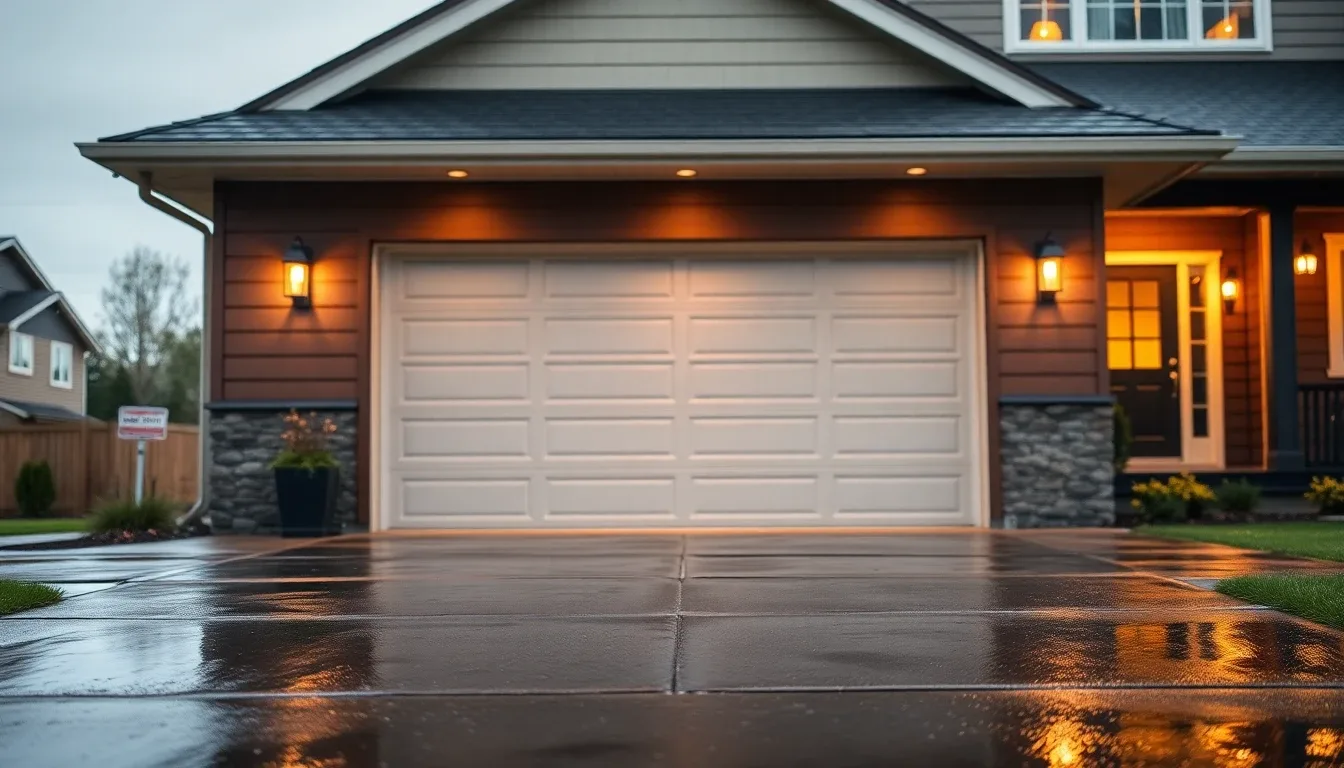
Your garage door is the heaviest moving object in your house, and it runs several times a day, usually without a thought, until the morning it doesn't. In the Puget Sound region, most failures aren't random. Doors tend to wear out in a predictable order, and the damp climate, windstorms and salt air push that order along.
Knowing what usually fails first, and what each failure looks and sounds like, helps you catch problems early, avoid damaging a good part, and tell a quick fix from a job that needs a professional. This guide walks through the major components, from springs to panels, with the symptoms, causes and costs a technician sees every week across King, Snohomish, Pierce and Kitsap counties.
Why Garage Doors Wear Out in a Pattern Here
A typical residential door cycles four to six times a day. Over a year that's well over a thousand cycles, and every cycle loads the springs, rollers, hinges, cables and opener the same way.
Our weather adds three stressors:
- Constant moisture. Seattle-area homes sit in damp air for much of the year. Steel hardware picks up surface rust, lubricants wash out, and wood or MDF-core door sections can swell at the bottom edge.
- Wind. Fall and winter windstorms rattle door sections, loosen track bracket bolts and throw debris at panels. A big gust against a door with a weak track mount can nudge it out of alignment.
- Salt air. Homes near the Sound, such as Edmonds, Mukilteo, Des Moines and parts of Kitsap County, see faster corrosion on springs, cable ends, bolts and track fasteners than homes farther inland.
The result is that springs and rollers wear mechanically, openers fail electrically or in the gear train, and panels and tracks fail from impact and corrosion. Here's how each one tends to go.
Springs: The Part That Does the Real Work
A 150-pound door feels nearly weightless when you lift it by hand because the springs carry almost all of the load. The opener only guides the door. That's also why a broken spring is the most common reason a door "just stopped working" and why the opener strains or fails if you run it with a broken spring.
How torsion springs fail
Most newer Seattle-area homes have a torsion system: one or two springs mounted on a steel shaft above the door opening. Springs are rated in cycles. A standard builder-grade spring is commonly rated around 10,000 cycles, which at five cycles a day is roughly five and a half years. Many builders install the cheapest option, so a spring failing at that point isn't unusual. Higher-cycle springs rated 15,000 to 25,000 or more cost more up front and can last far longer.
Signs of a spring on its way out:
- A visible gap in the coil, which means it has already snapped
- A loud bang from the garage, often described as a gunshot
- A door that feels extremely heavy or only lifts a few inches
- Rust streaking along the coils, especially common near saltwater
- A door that slams down or drops quickly when you disengage the opener
What a proper torsion spring replacement involves
Garage door torsion spring replacement is not a casual DIY job. The spring is wound under enough tension to cause serious injury, and it must be wound with the correct winding bars, never screwdrivers or improvised tools. A correct job also means matching the spring to the door: wire size, inside diameter, length and winding direction (left-wound and right-wound springs aren't interchangeable). A spring like 0.218 inch wire, 1.75 inch inside diameter and 32 inches long is a different animal from a 0.225 inch spring of the same length.
A good technician will also inspect the cables, drums, bearing plates and center bracket while the door is balanced and unloaded, because these wear on the same schedule as the springs. If one spring in a two-spring set breaks, the other is usually close behind, so replacing both is standard practice.
What garage door spring repair costs
Homeowners always ask about garage door spring repair cost. It varies with spring type, wire size, cycle rating, whether one or two springs are needed, and what else is worn. Standard-cycle replacement is the lower end. Upgrading to high-cycle springs, replacing a bent shaft or replacing frayed cables raises the total. Extension springs, found on many older homes, are generally cheaper but need safety cables to be installed correctly. Rather than trusting a number from a website, ask for a written quote that names the spring size and cycle rating so you can compare apples to apples.
Rollers, Tracks and Getting a Door Back on Track
If springs are the muscle, rollers and tracks are the skeleton. They determine whether the door travels smoothly or fights itself.
Why rollers deserve attention
Many homes built in the 1970s through the 1990s, such as those in tract neighborhoods around Lynnwood, still have the original steel rollers with exposed or loose bearings. They rust, flat-spot and grind in the track. You'll hear a rumble or squeal, feel vibration in the wall shared with the living space, and see the door shake as it travels.
A nylon garage door roller replacement in Lynnwood, or anywhere in the region, is one of the best upgrades per dollar. Nylon rollers with sealed ball bearings (a 10-ball bearing roller is common) run much quieter than steel and resist moisture better than open-bearing steel rollers. Details a technician checks:
- Stem length: 4 inches is standard for residential doors, while some doors use 2 inches.
- Wheel diameter: Almost always 2 inches for residential tracks.
- Hinge position: Rollers in the bottom bracket are under cable tension and should only be replaced by a trained tech, because the bottom bracket is under spring load.
Nylon rollers don't last forever. Expect to inspect them every few years, and replace them if you see cracks, flat spots, or wobble at the stem.
When a door comes off its track
Rollers jump out of tracks for a few common reasons: a bent track from a car bumper or a hard strike, loose bracket bolts that let the track drift, a broken roller, or one broken cable that lets one side drop. The gap at the jambs shows up first. A door that's crooked, jammed halfway, or hanging with one corner low is off-track, and you shouldn't run the opener or try to force it back into place.
Forcing it can bend the track further, crimp sections, and in the worst case drop the entire door. Even a seemingly minor off-track case may mean cables or springs are compromised. That's why any garage door off track repair in Algona, WA or elsewhere should begin with disconnecting the opener and inspecting spring and cable tension, not just popping the roller back in.
Track realignment: a repair people overlook
Not every problem needs new parts. Garage door track realignment in Edmonds is a common job because hillside lots, salt air and wind loosen the lag bolts and carriage bolts that hold the vertical and horizontal tracks. Over time the tracks drift out of parallel, which makes the door rub, bind or pop out.
A proper realignment checks that:
- The vertical tracks are plumb and parallel to each other.
- The gap between door edge and track is equal on both sides.
- The horizontal tracks are level, or slope slightly down toward the back as designed.
- Every bracket is tight, and any stripped lag holes are re-secured with proper hardware (often longer lags or through-bolts).
- There are no dents or crimps in the track where rollers travel.
If a track is creased, it's usually cheaper to replace it than to hammer it flat. Hammering often leaves a bump that wears out rollers fast.
The Opener: Gears, Boards and Mechanical Wear
Openers last a long time, often 10 to 15 years or more, but they fail in two distinct ways: mechanical and electronic.
Stripped gears
Many chain and belt drive openers use a plastic (nylon) drive gear, sometimes called the worker gear, to transfer motor power to the drive shaft. It's designed to be softer than the steel worm gear so it wears first, which protects the motor. Over years, especially if the door is out of balance or the springs are weak, the teeth wear down and strip.
The classic symptom is hearing the motor run and seeing the trolley or carriage not move, or hearing a grinding, clicking or ratcheting noise. Sometimes the door moves a few inches then stops. Plastic shavings (often white or gray) collected in the gear housing are a giveaway.
Replacing the gear is often far cheaper than replacing a whole opener, provided the unit is a model that has gear kits available and the motor and board are healthy. That's why garage door opener gear repair in Kirkland is a common request, especially from owners of well-built openers they'd rather keep. The same applies to garage door opener gear repair in Tukwila, where many homes have older, still-solid opener units.
Before paying for gear repair, a tech should confirm door balance. A door that's properly balanced should stay put when lifted about halfway by hand with the opener disconnected. If the springs are worn, a new gear will just strip again.
Circuit board failures
The logic board controls the remote receiver, safety sensors, wall control, limits and motor relay. Failures usually come from:
- Power surges, especially after storms or outages
- Moisture getting into the housing through condensation or a leaky garage roof
- Age-related failure of relays and capacitors
- Insects and spider nests (a surprisingly common issue in damp garages)
Symptoms include a unit that's dead, one that clicks but doesn't run, erratic behavior, remotes that stop working, or lights that flash with no pattern. Mercer Island, with its older homes, mature tree cover and humid garages, sees plenty of these. Garage door opener circuit board repair on Mercer Island can sometimes mean replacing just the board rather than the opener, which is a smart option for a quality unit with a healthy motor. For openers over 15 years old, or models with discontinued boards, a full replacement often makes more sense. A tech should talk through both options honestly.
A basic homeowner check: unplug the opener for a minute, then plug it back in, and try the wall control first, not the remote. If the wall button works but the remote doesn't, the problem is likely the remote, its battery or the receiver. If nothing works, look at the outlet and any GFCI that may have tripped.
Safety Sensors: Small Parts, Frequent Calls
Photo-eye sensors sit about 6 inches above the floor on each side of the door. They send an invisible beam across the opening. If something interrupts it, the door reverses. Required on all modern openers, they're also a top reason a door closes partway and reverses, or refuses to close at all.
Quick diagnostic steps:
- Look at the indicator lights. A steady light on both sensors usually means they're aligned and powered. A dim or blinking light means misalignment or a wire problem.
- Wipe the lenses. Spider webs, dust and road film cause false blocks.
- Check the mounting brackets. A bumped bracket by a few degrees is enough to break the beam.
- Follow the low-voltage wire. Staples through the wire, chewed insulation (rodents love garages) or corroded terminal screws are classic culprits.
- Consider sunlight. Low winter sun hitting the receiving sensor directly can interfere, especially on west-facing doors.
If these steps don't fix it, you may need a new sensor pair or a new wire run. Many homeowners searching for garage door sensor repair in Algona, WA have an older home where wiring has been disturbed during other work. If the sensors are fine but the door still won't close, the problem might be on the logic board, which is why a technician tests the whole system. Never bypass or disable the sensors, because they're what prevents a closing door from injuring a child or pet.
Panels: When the Door Itself Is Damaged
Doors take damage. A backing-up car, a basketball, a fallen branch in a windstorm or a pressure-washing accident can dent or crack a section. Moisture is another issue: the bottom section of a steel door can rust from standing water, and wood or composite sections can swell, delaminate or rot.
Garage door panel replacement is practical when the damage is limited to one or two sections and the door model is still available. Considerations:
- Match: The new panel must match the style, thickness, profile and color. Some manufacturers discontinue lines or change paint formulas, so older doors may be hard to match.
- Structure: Damaged sections weaken the door's rigidity. A cracked panel can cause hinges to pull loose or put stress on other sections.
- Insulation: If the door is insulated, the replacement needs the same R-value or the door will be unbalanced.
- Balance: Adding or removing weight changes balance. The springs may need to be adjusted after a panel swap.
If the door is more than 15 to 20 years old, has multiple damaged sections, or is badly worn elsewhere, it may be more cost-effective to put the money toward a new door. For a door that's in otherwise good shape, a single-panel replacement is a reasonable fix.
A Simple Maintenance Routine for Puget Sound Garages
Most of the failures above can be delayed with a few minutes twice a year. Fall, before the wet season, and spring, after it.
- Look and listen. Run the door and note any new sounds: grinding, popping, scraping.
- Check the balance. Disconnect the opener (pull the red release cord with the door closed), lift the door by hand halfway, and see whether it stays put.
- Lubricate moving parts. Use a garage-door-specific lubricant (silicone or lithium-based) on rollers, hinges and spring coils. Avoid heavy grease in the tracks, because it collects dirt.
- Tighten hardware. Check track brackets and hinge bolts, since they loosen with vibration and wind.
- Clean the tracks with a rag. Don't lubricate them.
- Test the auto-reverse. Place a 2x4 laid flat on the floor under the door. The door should reverse when it touches it.
- Test the sensors by waving an object through the beam while the door closes.
- Rinse salt and grime off exposed hardware if you're near the water.
- Don't touch the springs, cables and bottom brackets. They're under high tension.
Frequently Asked Questions
How do I know if my garage door spring is broken?
A visible gap in the coil is the clearest sign. You may also have heard a loud bang, noticed the door is very heavy, or found that the opener runs but the door barely moves. Don't keep running the opener, because it can burn out the motor or strip the gear.
Should I repair or replace my garage door opener?
If the motor is healthy and the unit is still supported with parts, repairing a stripped gear or replacing a circuit board can be cost-effective. If the opener is very old, lacks modern safety features, or a major repair would cost close to a new unit, replacement usually makes more sense.
Why does my garage door go down and then back up?
Usually it's a safety sensor issue (misalignment, dirty lenses, damaged wire) or the opener's travel limits need adjustment. A door that's binding in a bent track or out of balance can trigger the same reversal.
Can I put a door back on the track myself?
It's not recommended. An off-track door may have damaged cables, springs or tracks, and the system is under tension. Disconnect the opener and stay clear of the door until a technician can inspect it.
How often should garage door rollers be replaced?
There's no fixed interval. Steel rollers in older homes often need replacement sooner. Quality nylon rollers can last for years, but inspect them annually and replace them if they're cracked, worn or wobbling.
Is it worth fixing just one damaged panel?
Often, yes, if the rest of the door is in good shape and the model is still available. If the door is old, or parts can't be matched, replacing the full door can be better value.
Does salt air really make a difference?
Yes. Homes near saltwater see faster rust on springs, cables, fasteners and track hardware. More frequent lubrication and inspection help, and so does replacing corroded parts before they fail.
Get It Fixed Before It Gets Worse
Garage door problems rarely fix themselves, and small issues, like a noisy roller, a flickering sensor or a loose track bolt, tend to grow into bigger repairs. Whether you need a torsion spring swap, a track straightened, a stripped opener gear replaced, or a damaged section matched, Anderson's Garage Door Company serves Seattle and communities across King, Snohomish, Pierce and Kitsap counties. Call (253) 453-8862 to describe what you're seeing and get honest advice on whether a repair or replacement makes the most sense for your door.
Need this fixed today? We're local and ready.
Free phone estimates · Same-day service · 24/7 emergency line · Licensed, bonded & insured
Call (253) 453-8862