
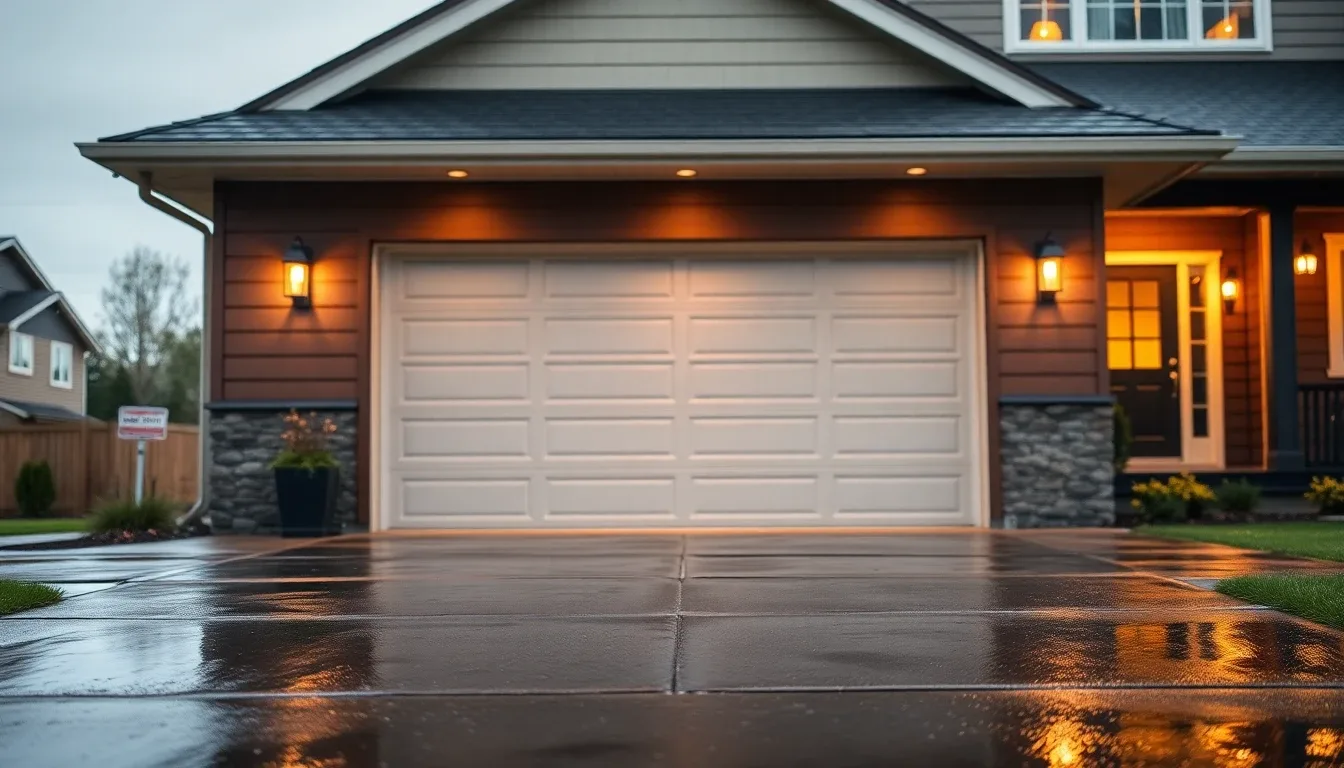
Most garage door trouble around Puget Sound starts small. A keypad needs three tries before it works. The door reverses halfway down on a rainy morning. A faint grinding noise gets a little louder each week. Then one day the door stops moving, usually when you're late for work.
Our climate causes a lot of that. Months of drizzle, damp air in the garage, windstorms that knock out power, and salt-laden air near the Sound all wear on the same parts: controls, sensors, rollers, seals, and opener electronics. This guide goes through those parts one at a time. For each, it covers what typically fails, what you can safely check yourself, and when a repair is smarter than a replacement. It's based on what the techs at Anderson's Garage Door Company see in King, Snohomish, Pierce, and Kitsap county garages.
Why Puget Sound Weather Is Hard on Garage Doors
Garage doors in dry climates fail from heat and sun. Here, the culprit is moisture, in three forms.
Constant dampness. From October through May, humidity inside an attached garage often stays high. Steel hardware gets surface rust, wire terminals corrode, and wood door bottoms and trim absorb water. Condensation can also collect inside electronics housings.
Wind and power events. Windstorms bring outages and, when power returns, brief surges. Openers have sensitive logic boards that don't love that. Wind also pushes rain sideways under worn bottom seals.
Salt air. Homes within a mile or two of saltwater, such as Dash Point, Browns Point, Edmonds, Gig Harbor, and parts of Kitsap, see faster corrosion on hinges, rollers, springs, and track fasteners. Galvanized steel holds up well, but not forever.
None of this means your door is doomed. It means a little attention to the right components pays off, and that a part that "should" last 15 years may last 8 if it's never been looked at.
Wall Controls and Keypads: The Parts You Touch Every Day
Controls take the most daily abuse and the least maintenance. When they act up, people often assume the opener is dying. Usually it isn't.
Wall Control Troubleshooting
If the wall button does nothing but your remote works, the problem is almost always the wall control or its wiring. Check these first:
- Lock mode. Many wall consoles have a "Lock" button. Holding it for about two seconds disables the remotes. Plenty of "dead remote" calls turn out to be a bumped lock button.
- Display and light. A console with no light at all points to a wiring or terminal problem.
- Terminals at the opener. Two thin wires, typically 18-gauge bell wire, screw into terminals on the back of the motor head. In damp garages these corrode and turn green or white. Unplug the opener, clean the wire ends, strip back fresh copper, and reconnect.
- Wire damage. Look along the run for staples driven through the insulation, rodent chewing, or a nick from a ladder. Old runs are often stapled too tight.
A quick test: with the opener plugged in, briefly touch a screwdriver across the two wall-control terminals at the motor head. Low voltage runs through that circuit. If the opener fires, the wire or console is bad. If nothing happens, the problem is further inside the opener.
For garage door wall control repair Newcastle WA homeowners usually call about one of two things. One is a console from the 1990s or 2000s that has finally failed in a hillside home with a damp garage. The other is a wire that was cut or pinched during a remodel. Both are quick fixes when diagnosed correctly. Replacing a console with a newer model from the same brand is usually inexpensive and often adds a motion-detecting light.
Keypad Repair vs. Replacement
Wireless keypads rely on a battery, usually a coin cell or a 9V depending on the model, and on a PIN stored in the opener's memory. Before you decide a keypad is dead, try the following:
- Replace the battery, even if you changed it "recently." Cold garages shorten battery life.
- Look for water inside the housing. Cracked flip covers and failed gaskets are common after a few Northwest winters.
- Reprogram it. Press the Learn button on the opener (its color tells you the technology generation), enter your four-digit PIN on the keypad, and press Enter within about 30 seconds. The opener light should flash or click.
If the keypad lights up but the door ignores it, reprogramming usually solves it. If the buttons are worn smooth, unresponsive in the rain, or the display is dead, replacement is the better call.
Here is how the cities in our service area tend to differ:
- Milton: Homes here are often 1990s and 2000s builds with openers around 15–20 years old. Garage door keypad repair Milton WA calls are usually about reprogramming, a failed battery contact, or a keypad that has taken on moisture. We can often get it working in one visit.
- Lake Stevens: Many homes here are close to the lake or in newer developments with openers of mixed ages. Garage door keypad replacement Lake Stevens jobs are often about compatibility. Keypads must match the opener's frequency and security protocol, and a keypad from a different era won't pair.
- Tukwila: Older ramblers and mixed-use properties often run older openers. Garage door keypad replacement Tukwila projects frequently involve checking whether the opener itself is still supported, since replacement keypads for discontinued openers can be hard to find.
When you mount a new keypad, put it at least five feet off the ground, out of reach of small children, under cover if possible, and where you can reach it from the driveway.
Safety Sensors: The Most Common "Door Won't Close" Call
Federal safety rules have required photo-eye sensors on residential openers since 1993. They sit about six inches above the floor, one on each side of the door. If something breaks the invisible beam, the door reverses. When the sensors are misaligned or dirty, the door refuses to close, or it closes and immediately pops back up.
Check these in order:
- Indicator lights. On most Chamberlain-built units, the receiving sensor shows a steady green light and the sending sensor shows amber. A dim, flickering, or dark light means misalignment or a wiring issue. Many openers also blink the opener's lights about 10 times if they can't detect the sensors.
- Lens cleanliness. Wipe both lenses with a soft cloth. Spiderwebs and dust are surprisingly common culprits, especially in damp, shaded garages.
- Alignment. A bumped bracket, a lawnmower, or a bike handlebar can shift one sensor. Loosen the wing nut, aim them at each other until both lights hold steady, and tighten again.
- Sunlight. Low winter sun entering a garage at a bad angle can wash out the receiving eye. A small shade or cardboard tube can help.
- Wiring. Trace the thin wire from each eye back to the opener. Staples, kinks, and corroded splices are the usual failure points.
If the sensors look perfect and the light never comes on, one of them has probably failed. Garage door sensor repair Pacific WA calls are typical for this: homes with open, windy exposure near the Green River valley and damp garages where connectors have corroded. A replacement pair is inexpensive, and the swap takes only a short visit.
Never bypass or disable the sensors, and never tape over them. They are the opener's main safeguard for kids and pets. After any sensor work, run the auto-reverse test: lay a 2x4 flat on the floor under the door and close it. The door should reverse the moment it touches the board.
Opener Brains and Brawn: Circuit Boards and Craftsman Openers
If the controls and sensors are fine and the opener still misbehaves, the problem is likely in the opener itself. Two scenarios are especially common here.
Circuit Board Failures
The logic board is the opener's brain. It reads the remotes, controls the motor, monitors the sensors, and manages the lights. Common signs of a failing board:
- The opener hums or clicks but the motor doesn't run
- Lights flash, but the door doesn't respond
- Remotes work intermittently, then stop
- The wall control is dead even though the wiring checks out
- A burnt smell or visible dark spots on the board
Power surges after storms are a classic cause. Moisture creeping into the head unit is another, and so are ants and spiders. In newer openers, the Learn button LED can flash diagnostic codes that point to the specific fault.
Garage door opener circuit board repair SeaTac customers ask about is often a judgment call. If the opener is under about 10–12 years old and the motor, gears, and rail are in good shape, a replacement board can be a smart, economical repair. If it's older, noisy, or lacks modern safety features like battery backup or rolling-code security, putting money into a new board may be throwing good money after bad. A good tech will tell you which side of that line you're on. Adding a surge protector to the outlet is cheap insurance either way.
Craftsman Opener Issues
Craftsman openers have been built by Chamberlain for decades, so their parts and behavior closely match LiftMaster and Chamberlain models. That helps: parts are widely available, and the diagnostics are familiar.
On older units, the most frequent issues are:
- Stripped drive gear. A nylon gear inside the head unit wears down. The motor runs but the trolley doesn't move, or you hear a grinding or whirring sound. A gear and sprocket kit is the repair.
- Limit and force settings. If the door stops early or reverses at the floor, the limit or force settings may have drifted.
- Circuit board or capacitor failure. The same electrical issues described above.
- Worn remotes or receivers. Sometimes the opener is fine but the radio receiver or remote isn't.
If you're comparing Craftsman garage door opener repair with replacement, consider age, repair cost, and features. A straightforward gear kit on a decent opener is usually worth it. A failed board on a 20-year-old, single-speed chain drive with no battery backup is where replacement starts making sense.
Rollers, Tracks, and Salt Air
The opener gets blamed for a lot of noises that actually come from the door. Rollers are a prime example. A typical four-section, 7-foot-tall door uses 10 rollers, and each one rides in the track thousands of times a year.
Signs Your Rollers Are Done
- Rumbling, grinding, or squealing during travel
- Visible flat spots, cracks, or chipped nylon
- Rust or pitting on steel rollers
- Wobbling stems
- A door that shakes or looks uneven as it moves
Standard steel rollers with exposed bearings tend to wear out first, especially in damp or salty conditions. Nylon rollers with sealed bearings run quieter and typically last longer, which makes them a good upgrade in our climate.
Garage door roller replacement Dash Point Federal Way homeowners ask about often comes down to salt air. Within a mile or so of the water, corrosion hits rollers, hinges, and track fasteners faster, and steel rollers can seize or pit in just a few years. Switching to sealed nylon rollers and wiping down hardware regularly can add years to the system.
A safety note: You can replace the middle rollers on many doors if you're careful, but the bottom rollers sit in brackets attached to the lift cables, which are under extreme spring tension. Don't loosen those brackets. Spring and cable work causes serious injuries every year and is not a DIY job.
For broader garage door repair Dash Point Federal Way homes need, it helps to treat the whole system as one. That includes hinges (look for cracks at the screw holes), cable fraying at the drum, track alignment, and spring condition. Salt air accelerates all of them. A seasonal inspection catches problems before a spring breaks or a cable jumps.
To lubricate, use a silicone or lithium-based garage door spray on hinges, roller stems, and spring coils. Don't grease the inside of the track, because grease collects dirt. And skip heavy WD-40 as a long-term lubricant, since it's a solvent that can wash
Need this fixed today? We're local and ready.
Free phone estimates · Same-day service · 24/7 emergency line · Licensed, bonded & insured
Call (253) 453-8862