
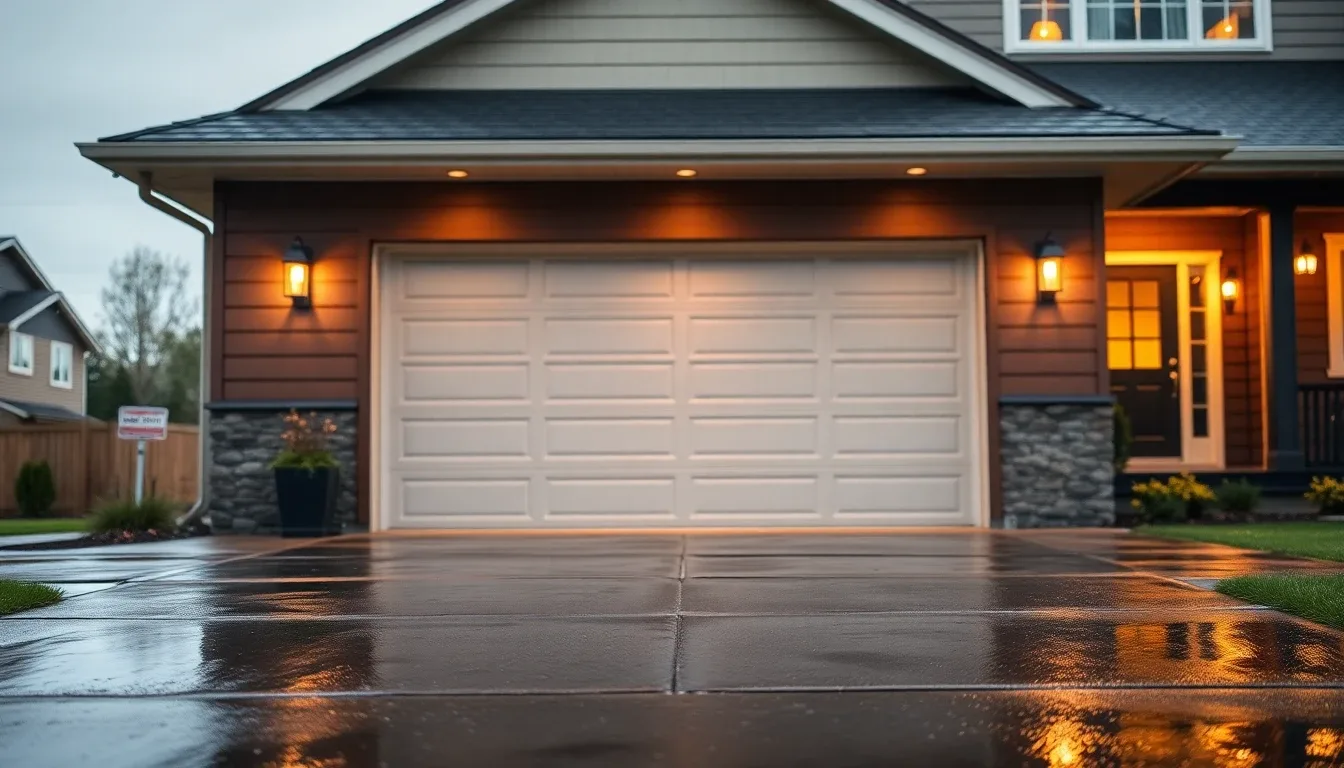
Your garage door is the largest moving object in your house, and in western Washington it takes a beating. It sits through months of rain, wind off the Sound, and moss-friendly dampness, and it opens and closes thousands of times a year. When it starts acting up, you face a practical question: pay for a fix, or put the money toward a new door?
The answer depends on what is actually wrong. A misaligned sensor, a worn roller, or a torn bottom seal is a cheap fix that can add years of life to a door. A rotted wood panel, a door that has been patched repeatedly, or sections that are bowed and delaminating usually point toward replacement.
This guide walks through how to tell the difference. It covers the common problems we see across King, Snohomish, Pierce, and Kitsap counties, what you can reasonably try yourself, and what you should leave to a professional. It also covers what a new door costs and when a custom installation is worth the extra money.
First, Figure Out What Kind of Problem You Have
Garage door problems fall into three groups, and sorting yours into one of them saves time and money.
Control problems involve the opener, sensors, remotes, and wall button. The door itself is mechanically fine, but it won't respond correctly. These are usually inexpensive.
Wear problems involve rollers, hinges, cables, springs, and seals. These parts are designed to wear out. Replacing them on schedule is normal ownership, not a sign the door is failing.
Structural problems involve the door sections themselves: cracked panels, rotted bottom edges, sagging, or rusted-through steel. These are the ones that tip the decision toward replacement.
A rough rule: if the door panels are straight, intact, and reasonably insulated, repair almost always makes sense. If the panels are failing, you'll keep paying for repairs that don't last. A good garage door repair service will tell you honestly which situation you're in, even when the answer is "this door has had its run."
Control Problems: Cheap Fixes That Cause Big Headaches
Garage Door Photo Eye Alignment Renton Homeowners Can Try First
Federal safety rules require every residential opener to have a pair of photo eyes mounted near the floor. They send an invisible beam across the door opening, and if something breaks that beam while the door is closing, the door reverses. When the eyes get knocked out of line, the door refuses to close, or it starts down and bounces back up. The opener's lights often blink as a warning.
In wet climates like ours, photo eye trouble is common. A bumped bracket from a bike or a recycling bin is the usual culprit, but we also see spiderwebs, splashed mud, and condensation on the lenses. In older Renton homes with garages that sit slightly below the street grade, the eyes sit close to where water splashes in.
If you're dealing with garage door photo eye alignment in Renton or anywhere else, here is the sequence we'd follow:
- Look at the indicator lights on both eyes. The sending eye usually shows a steady light, and the receiving eye shows a steady light when aligned. A dim or flickering light means misalignment or a bad connection.
- Wipe both lenses with a dry microfiber cloth.
- Check that both brackets are at the same height, typically 4 to 6 inches above the floor, and that they're tight against the track or wall.
- Loosen the wing nut on the bracket, nudge the eye until the light steadies, and retighten.
- Check the thin low-voltage wires for staples that have pinched them or for rodent damage. Garages in wooded neighborhoods see more of this than people expect.
If the lights stay dark after realignment, the wire or the eye itself has failed. That's a quick repair, but one that's best left to a technician if the wire runs through finished walls or the ceiling.
Remote Programming and the LED Bulb Problem
Remotes lose their programming after a battery change, a power surge, or an opener replacement. Most modern openers use rolling-code technology, so each button press sends a new code that the opener has to recognize. Pairing is usually done with the "learn" button on the motor unit: press it, then press the remote button within about 30 seconds. The exact steps vary by brand, so check your model's manual.
Garage door remote programming around Lake Forest Park often comes with a twist. Many homes there are tucked under tall evergreens on sloped lots, and the remote range can suffer from distance, terrain, and signal blockage. Another culprit is cheap LED bulbs. Some LED bulbs put out radio interference that cuts the opener's receiving range dramatically. If your remote only works when you're in the driveway, try swapping the bulb in the opener for one labeled "garage door opener compatible" before you assume the remote or receiver is bad.
Two more tips: if you ever lose a remote, clear the opener's memory (typically by holding the learn button about six seconds) and reprogram only the remotes you still have. And if a keypad stops working, replace its battery before anything else.
Wear Parts: Rollers, Hinges, and Why They Matter
Why Roller Condition Shows Up in Your Daily Life
Rollers guide the door up and down in the track. A typical residential door has 10 rollers or more, and when they're worn, you'll hear it: grinding, rattling, or a rumble that carries into bedrooms above the garage. Worn rollers also make the opener work harder, shortening its life.
Garage door roller replacement is a common request in Pacific, WA, where homes in the Algona-Pacific area often have the original builder-grade doors from the 1990s and 2000s. Those doors usually came with basic steel rollers, often with exposed or loose bearings that dry out and seize over time.
Nylon Rollers: The Upgrade Most Homes Benefit From
For nylon garage door roller replacement in Bothell, the common request is quiet operation, and nylon is the right answer for most homes. A quality nylon roller has a nylon wheel around sealed steel ball bearings, usually 10 to 13 bearings in better models. Compared with plain steel rollers, they're quieter, they don't rust the way exposed steel does in damp conditions, and they're gentle on the track.
What to look for when buying:
- Stem length and wheel size. Most residential doors use a 2-inch wheel with a 4-inch stem, but check yours. Wrong stems cause binding.
- Sealed bearings. Avoid cheap nylon rollers with loose bearings.
- Bearing count. More bearings generally means smoother travel.
Once installed, the rollers should be wiped clean and the track left dry. Many people spray lubricant into the track, which collects dirt and gums up. Light lubrication belongs on the hinges and roller bearings, not on the track surface.
A Safety Warning About Bottom Brackets
Rollers on the middle hinges are straightforward to replace if the door is closed and you do it carefully. The bottom bracket is a different story. On most doors, the bottom bracket holds the lift cable and is under extreme spring tension. Loosening it without releasing tension has caused serious injuries. If your rollers are worn, replace the ones you can reach safely, and have a technician handle the bottom corners and anything involving cables or springs.
Sealing Out the Weather: Retainers and Weather Stripping
Bottom Retainers
The bottom seal on a garage door sits in an aluminum or plastic channel called a retainer. Most retainers have either a "T" style track (two slots) or a bulb-style track (a round bead channel). When the seal tears or the retainer cracks, you get gaps, drafts, and in heavy Pacific Northwest rain, water running into the garage.
A garage door bottom retainer replacement in Bothell is often needed in older neighborhoods where the original door has lasted two decades. Constant moisture can corrode the aluminum, and on wood doors, the bottom edge can swell, rot, or split around the retainer fasteners. Replacing a retainer takes more than swapping a seal, because the old one must come off cleanly, the bottom panel edge must be sound, and the new one must be the right profile and width for the door.
If the bottom panel itself is soft or rotted, a new retainer won't hold. That is one of the clearest signs that you're moving from a repair into replacement territory.
Weather Seal Installation
Side and top stops, the vinyl or rubber strips that press against the door when closed, matter just as much. A proper garage door weather seal installation in Sumner, WA matters for homes near the Puyallup River valley, where damp air, moss, and leaf debris get into every gap. Windblown rain during a fall storm will find a gap of a quarter inch.
When you're evaluating a seal job, check:
- Compression. The seal should touch the door evenly along its full length, with no gaps or crushed spots.
- Material. Vinyl stays flexible across temperature swings. Cheaper rubber can harden and crack.
- Fastening. Stainless or coated screws hold better and resist rust near salt air.
- Frame condition. If the wood jamb is rotted, the seal has nothing solid to attach to.
For homes closer to the water, including parts of Kitsap and the Sound-facing side of Pierce and King counties, salt air also speeds up corrosion on screws, hinges, and springs. Stainless hardware and rinsing the lower portion of the door occasionally can extend its life.
When the Door Stops Halfway
Garage Door Stuck Halfway in Federal Way: What It Usually Means
A garage door that stops midway is one of the most alarming problems, and it's rarely random. If your garage door is stuck halfway in Federal Way, the cause is usually one of these:
- A broken torsion spring. The opener can't lift a 150-pound-plus door on its own, so it strains and stops. You'll often have heard a loud bang earlier.
- A cable off the drum or snapped. The door tilts or hangs crooked on one side.
- Bent or misaligned track. Often caused by a car bump or by settling.
- Opener force or travel limits set incorrectly. The opener believes it has finished or hit an obstruction.
- Swollen or dirty rollers and tracks. Wet weather and debris add friction.
What not to do: don't keep pressing the button. Repeated attempts can burn out the opener or pull a cable off its drum. Disconnect the opener with the red emergency release cord only if the door is fully closed or you can support it safely. Never try to adjust springs, bottom brackets, or cables yourself. Those parts are under enough force to cause serious injury.
Door stuck? Call a garage door repair service that can diagnose it properly. Broken springs and slipped cables are often fixable the same day, and replacing springs in pairs is usually the smarter long-term move, since the second spring is the same age and has had the same cycles.
New Garage Door Cost and Custom Installation
What You Can Expect to Pay
New garage door cost varies widely based on size, material, insulation, windows, hardware, and installation complexity. Here are typical ranges for installed doors in our region. Treat them as ballparks, since your actual quote will depend on your opening and options:
- Basic single-layer steel, single-car: roughly $1,000 to $2,000 installed.
- Insulated steel, two-car: often $1,800 to $4,000 or more.
- Wood-look composite or higher-end steel with windows: frequently $3,500 to $7,000 or more.
- Custom wood or architectural designs: can run well above $5,000 and climb quickly with size and finish.
Extra costs that surprise people include removal and disposal of the old door, new torsion springs or tracks if the old ones are worn, jamb repair, a new opener, and permits where required.
When Custom Is Worth It
Custom garage door installation makes sense when the standard catalog doesn't fit your home. That could be an unusual opening size, a Craftsman-style home where a carriage-house or wood-grain door matters to the curb appeal, or a historic Seattle neighborhood with design standards. It also makes sense if you want a specific material, such as cedar, which looks great in the Northwest but needs regular sealing and maintenance in our damp conditions.
For most homeowners, a well-insulated steel door with a wood-grain finish gives the look of custom at a lower price and with far less upkeep. If you're going fully custom, plan for lead times of several weeks, ask about the finish system (especially for wood), and make sure the springs and track are matched to the door's actual weight. Custom doors are often heavier than standard ones, and mismatched springs will fail early.
Repair vs. Replace: A Simple Test
Consider replacement if:
- Two or more sections are cracked, rotted, or bent.
- The door is uninsulated and you use the garage as living space or a workshop.
- Repair quotes in the last couple of years add up to more than 40 to 50 percent of a new door.
- Parts for an old brand or style are hard to find.
Otherwise, repair and keep going.
A Practical Maintenance Rhythm for the Northwest
You can head off most of the problems above with a simple routine:
- Every month: Test the safety reversal by placing a 2x4 flat on the floor under the door. It should reverse when it touches. Wipe the photo eye lenses.
- Twice a year: Tighten hardware, check rollers and hinges, and lubricate hinges and roller bearings with a garage-door-specific lubricant.
- Each fall: Inspect weather seals and the bottom retainer before the rain sets in. Clear the pine needles and leaves from the tracks and bottom edge.
- Every year: Do the balance test. With the door closed, pull the release cord, then lift the door by hand to waist height. If it falls or flies up, the springs need professional attention.
- Any time you hear something new: Don't wait for it to get worse.
Frequently Asked Questions
How long should a garage door last in western Washington?
A well-maintained steel door can last 20 years or longer. Wood doors need more upkeep in our damp climate. Springs commonly last around 10,000 cycles, which for many families is roughly seven to ten years, though this varies with use.
Can I replace garage door rollers myself?
You can often replace the rollers on middle hinges if you're careful and the door is closed. The bottom corner brackets are under heavy tension and should be left to a professional.
Why does my garage door reverse when it touches nothing?
Usually it's a photo eye issue (misalignment, dirty lenses, or a damaged wire) or the opener's down-force setting is too sensitive. Check the eyes first.
Do I need to replace the whole door if the bottom is damaged?
Not always. If the panel is solid, a new retainer and seal can fix it. If the bottom section is rotted or bent, replacing the section or the whole door may be better. Section availability depends on the brand and age of your door.
Is a more expensive door always better?
Not necessarily. Insulation, quality hardware, a solid warranty, and proper installation matter more than the highest price tag. A well-installed mid-range door often outperforms a premium door that was installed poorly.
Get It Fixed Right the First Time
Whether you need a sensor realigned, rollers swapped for quieter nylon, a seal replaced before the next storm, or a full door replacement, Anderson's Garage Door Company can help. We serve homeowners across Seattle, King, Snohomish, Pierce, and Kitsap counties. Call us at (253) 453-8862 for honest advice on whether your door needs repair or replacement, and a clear quote before any work begins.
Need this fixed today? We're local and ready.
Free phone estimates · Same-day service · 24/7 emergency line · Licensed, bonded & insured
Call (253) 453-8862