
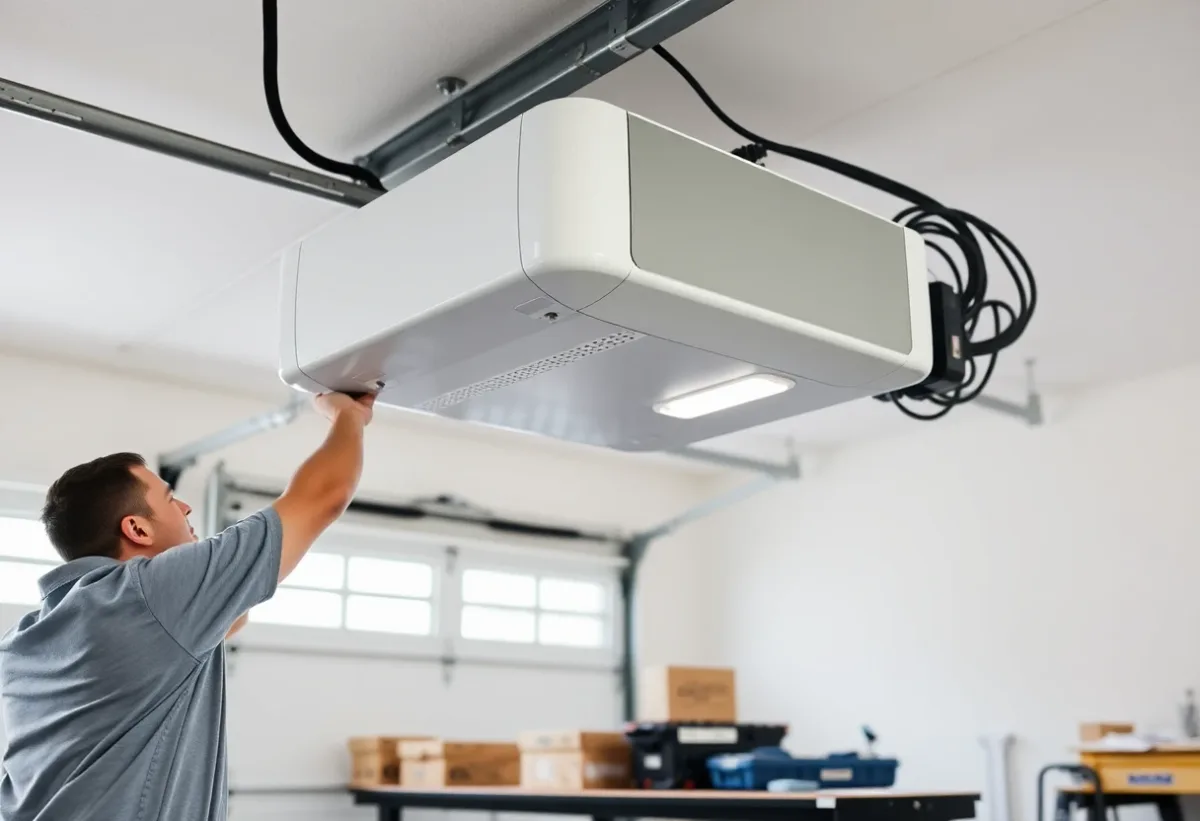
Anderson's Garage Door Company provides expert garage door opener installation across Seattle and the entire Puget Sound region — battery backup units, smart Wi-Fi openers, chain-drive openers, and more, with same-day appointments and flat upfront pricing.
Belt-drive, chain-drive, and wall-mount opener installation — smart openers, battery backup, and old opener replacement. Our technicians handle this work daily across King, Snohomish, Pierce, and Kitsap counties, and our trucks carry the parts to finish the overwhelming majority of jobs in a single visit.
One call to (253) 453-8862 gets you a real local technician, a clear quote, and in most cases a same-day fix.
Everything our garage door opener installation includes
"Garage Door Opener Installation" is a bigger category than it sounds. Under this service, our technicians handle:
Belt-Drive Opener Installation
Whisper-quiet belt drives ideal for bedrooms over garages. See the dedicated page for full details, or call (253) 453-8862 to book.
Chain-Drive Opener Installation
Rugged, budget-friendly chain drives for detached garages. See the dedicated page for full details, or call (253) 453-8862 to book.
Wall-Mount Opener Installation
Side-mount jackshaft units that free up ceiling space. See the dedicated page for full details, or call (253) 453-8862 to book.
Smart Garage Door Opener Setup
Wi-Fi openers with app control, cameras, and voice assistant support. See the dedicated page for full details, or call (253) 453-8862 to book.
Battery Backup Openers
Openers that keep working through Puget Sound power outages. See the dedicated page for full details, or call (253) 453-8862 to book.
Signs you need this service
The symptoms that lead to this service are consistent: battery backup units; smart Wi-Fi openers; chain-drive openers; wall-mount (jackshaft) openers. Each starts small and compounds with every door cycle — early attention is always the cheaper path.
Torsion springs are under extreme tension even when the door is closed. Every year people are hurt attempting DIY spring repairs with the wrong bars or by loosening set screws in the wrong order — please don't attempt it.
How our garage door opener installation process works
We've refined this process over thousands of service calls across the Puget Sound region, and it's built to respect your time and your budget.
1. Honest phone diagnosis
Describe the symptoms over the phone and we'll tell you what it probably is, what it probably costs, and whether it's safe to use the door until we arrive.
2. A real arrival window
We schedule tight windows and call when the technician is on the way — no vague "sometime between 8 and 5" promises.
3. Full-system inspection
The technician checks the entire door, not just the obvious broken part, so the quote you approve reflects everything the door actually needs — and nothing it doesn't.
4. Flat-rate quote, then work
We present options — good, better, best where it applies — with firm numbers. Only after you choose do tools come out.
5. Test, tune, and clean up
We cycle the door repeatedly, verify the safety systems, lubricate every moving part, and walk you through what was done before we leave.
Need a garage door fixed today?
Free phone estimates · Same-day service · 24/7 emergency line · Licensed, bonded & insured
Call (253) 453-8862How a garage door actually works (and why it fails)
Most homeowners never think about the machinery overhead until it stops. In reality, every door cycle coordinates a half-dozen subsystems, and the failure you can see is often caused by a part you can't. Here's the system our technicians evaluate on every call in Northwest garages:
Springs: the muscle
Torsion or extension springs counterbalance the door's full weight — often 150–350 pounds — so a motor rated like a blender can lift it. Springs are consumables rated in cycles, and they are always the most dangerous part to touch.
Cables and drums: the transmission
Cables transfer spring force to the bottom corners of the door. They stretch and corrode in our damp climate, and because they fail in pairs' worth of tension, we always replace them as a matched set.
Rollers and tracks: the guide rails
The tracks don't bear the door's weight — the springs do — but they define its path. A quarter-inch of misalignment is audible; a half-inch binds the door entirely.
Hinges and panels: the body
Hinges let the door bend around the track's curve; panels give it structure. A cracked hinge telegraphs clicking sounds, while a sagging top panel strains the opener bracket it carries.
The opener: the brain
The motor head, drive (belt, chain, or screw), logic board, and travel/force settings automate the door. Most 'opener failures' we diagnose are actually door problems forcing the opener past its limits.
Safety systems: the guardian
The photo-eye beam and auto-reverse force limits are non-negotiable safety gear. If your door only closes when you hold the wall button, the safety system is telling you something — don't bypass it, fix it.
Weather seals: the envelope
Bottom rubber, jamb stripping, and the header seal keep Puget Sound rain, drafts, and rodents outside. Flattened seals show up as puddles, pests, and cold garages — cheap to fix, expensive to ignore.
Built for Pacific Northwest conditions
Puget Sound windstorms flex wide doors in their tracks, power outages strand openers mid-cycle, and months of damp air quietly corrode cables from the inside out — which is why local experience matters when diagnosing a door.
That's the environment we spec parts for: corrosion-resistant cables and springs near saltwater, sealed-bearing rollers for damp garages, and weather seals chosen for months of rain rather than a sunny-climate catalog default.
A homeowner's garage door maintenance guide
A few minutes of seasonal attention dramatically extends the life of every component above. Here's the routine we recommend to customers — all of it safe for homeowners, none of it requiring tools near a loaded spring:
Monthly: watch and listen
Cycle the door and simply observe: smooth and quiet is healthy. Scraping, slapping, or a door that pauses mid-travel means wear is active and worth a phone call before it compounds.
Monthly: test the safety reverse
Block the photo eyes while the door closes (it should reverse immediately) and close onto a board laid flat on the floor (it should spring back). These two tests take one minute and are the ones that protect kids and pets.
Twice a year: lubricate the right way
Spring and fall, hit every pivot point with garage-door lube: hinge knuckles, steel roller bearings, spring coils, and the lock mechanism. Skip the tracks themselves — they should be clean and dry, not greasy.
Twice a year: check the balance
With the door closed, pull the red release cord and lift the door halfway by hand. It should float there. If it slams down or flies up, spring tension is off — reconnect the opener and book a tune-up; an unbalanced door is quietly destroying its opener.
Yearly: professional tune-up
Once a year, let a technician do what homeowners safely can't: set spring tension, calibrate opener force and travel, and torque the hardware. It's the cheapest insurance a garage door can buy.
The real cost of putting it off
Garage door failures cascade. A door with worn rollers runs crooked; a crooked door side-loads its cables; strained cables chew their drums; and the opener drags the whole mess until its gear strips. What starts as a $395-class visit becomes a multi-component repair — we see the pattern weekly, and it's the most preventable money in this trade.
There's also the stuck-at-the-worst-moment factor: doors don't fail at convenient times. They fail at 7 AM with your car inside, or at 11 PM stuck open in the rain. A planned repair this week beats an emergency call next month on both price and stress.
Our advice is free at (253) 453-8862 — describe what the door is doing and we'll tell you honestly whether it's a book-it-today problem or a keep-an-eye-on-it problem.
Straightforward pricing for garage door opener installation
Expect $395–$950 for typical garage door opener installation work across our service area. Door dimensions, part quality (standard versus high-cycle or corrosion-resistant), and the condition of surrounding hardware move the number within that range.
We quote flat rates, in writing, before work starts. The service-call fee is waived when you proceed with the repair, and we don't play the coupon-then-upsell games that give this industry a bad name.
We're licensed, bonded, and insured in Washington State, and our technicians are employees we've trained and background-checked ourselves.
What the numbers look like: garage door opener installation pricing
Here's how typical jobs break down. These are planning ranges from real invoices across our Puget Sound service area — your firm, flat quote comes before any work begins, and it's the number you actually pay.
| Job | Typical range | What moves the price |
|---|---|---|
| Belt-Drive Opener Installation | $395–$645 | Parts tier: standard vs. high-cycle / corrosion-resistant |
| Chain-Drive Opener Installation | $450–$740 | Standard-hours vs. evening/weekend scheduling |
| Wall-Mount Opener Installation | $505–$840 | Accessibility, track height & garage layout |
| Smart Garage Door Opener Setup | $560–$850 | Condition of surrounding hardware |
| Battery Backup Openers | $615–$865 | Door size & weight (single vs. 16-ft double) |
| Service call & diagnosis | $49 — waived with repair | Applied as a credit when you approve the work |
Where we provide garage door opener installation
We cover the entire Puget Sound metro from our Seattle shop: Snohomish, Mountlake Terrace, Poulsbo, Pacific, Tacoma, Issaquah, Mercer Island, University Place, and dozens more communities across four counties. Every city link below goes to a local page with response times and area-specific detail.
What makes Anderson's Garage Door Company different
Our team at Anderson's Garage Door Company has spent over a decade working on every door and opener brand sold in Western Washington, and we back that experience with upfront pricing and a written workmanship warranty.
Our reviews average 4.9 stars, and we've earned them one driveway at a time: showing up when we said we would, charging what we quoted, and fixing doors so they stay fixed.
If your door is hanging crooked, has a visibly separated spring, or has a cable dangling loose, stop using it immediately. Operating a compromised door can bend tracks, strip opener gears, and turn a modest repair into a full replacement.
And because we're local, accountability is real: the technician who fixes your door this year is the company you'll call next year. That long-game incentive — rare in an industry full of lead-generation fronts — is why we'd rather under-promise, over-deliver, and earn the next referral on your street.
Frequently asked questions
Belt drive or chain drive — which should I choose?
Belt drives are the quiet choice, ideal when bedrooms or offices sit above or beside the garage. Chain drives cost a bit less and shrug off heavy doors and detached-garage duty. We'll recommend based on your door weight and garage layout.
How much does garage door opener installation cost?
Most garage door opener installation jobs run between $395 and $950, depending on door size, parts quality, and how much related hardware needs attention. We give you a firm, flat quote before starting — the price you approve is the price you pay.
Do you warranty garage door opener installation work?
Yes. Labor is covered by our written workmanship warranty, and parts carry their manufacturer warranties — which we register on your behalf. If something we installed misbehaves, we come back and make it right.
Is it safe to use my door until the technician arrives?
If the door is crooked, a spring is visibly separated, or a cable is hanging loose — stop using it. Running a compromised door can bend tracks and strip opener gears, turning a modest repair into a much bigger one. Disconnect the opener and leave the door where it is until we arrive.
How long does garage door opener installation take?
Most appointments are finished in 60–120 minutes. Our trucks carry the common parts for every major brand, so the overwhelming majority of garage door opener installation calls are completed in a single visit.
Do you service all brands for garage door opener installation?
We work on every major residential brand — LiftMaster, Chamberlain, Genie, Craftsman, and Marantec openers; Clopay, Amarr, Wayne Dalton, C.H.I., and Raynor doors — plus builder-grade and discontinued brands found in older Puget Sound homes.
Can my new opener work with my phone?
Yes — every smart opener we install includes app setup before we leave: open/close from anywhere, alerts when the door operates, and schedules that close the door automatically at night.
Can I get same-day garage door opener installation?
Usually, yes. Call (253) 453-8862 before early afternoon and we can typically have a technician out the same day. Emergency situations — doors stuck open, vehicles trapped — are prioritized around the clock.
Ready when you are — 7 days a week, 7:00 AM – 9:00 PM (24/7 emergency line)
Free phone estimates · Same-day service · 24/7 emergency line · Licensed, bonded & insured
Call (253) 453-8862Garage Door Opener Installation by city
- Garage Door Opener Installation in Snohomish
- Garage Door Opener Installation in Mountlake Terrace
- Garage Door Opener Installation in Poulsbo
- Garage Door Opener Installation in Pacific
- Garage Door Opener Installation in Tacoma
- Garage Door Opener Installation in Issaquah
- Garage Door Opener Installation in Mercer Island
- Garage Door Opener Installation in University Place