
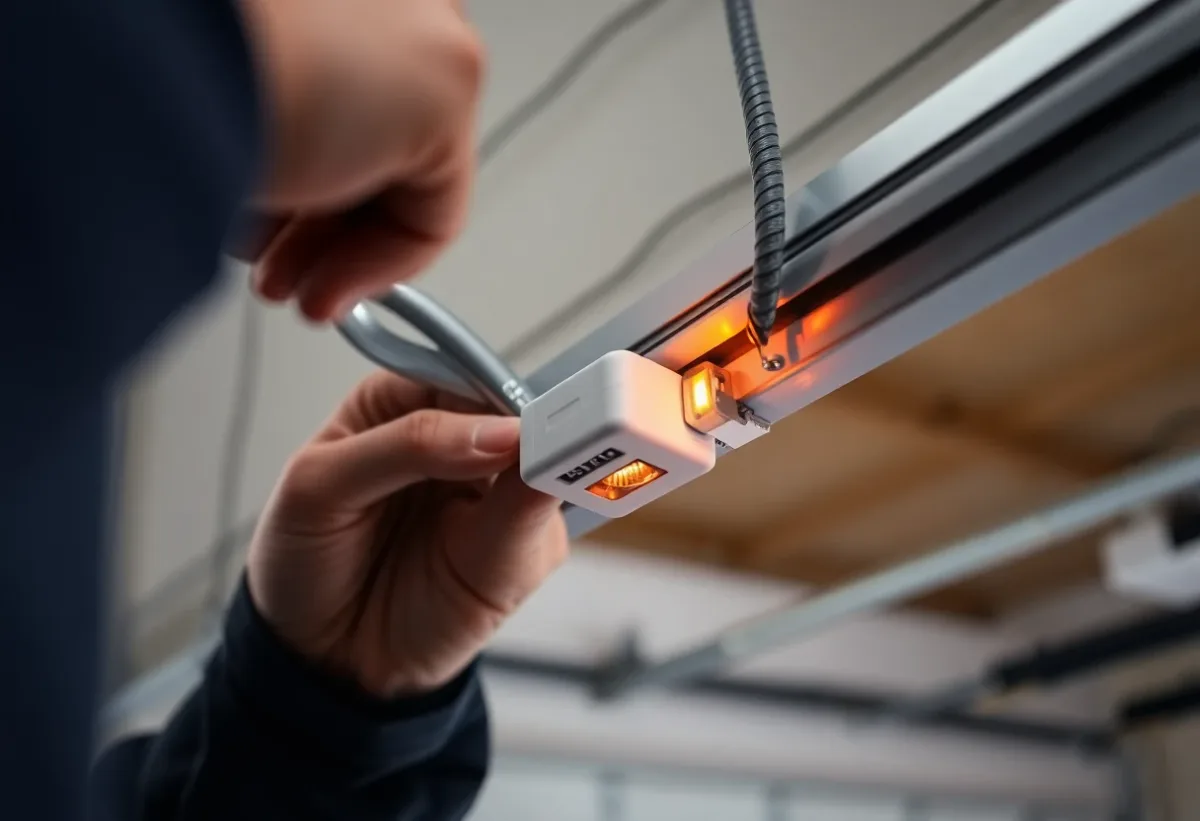
Anderson's Garage Door Company provides sensor replacement throughout Seattle and the Puget Sound region — new photo eyes for cracked, fogged, or failed sensors — with same-day availability and flat, quoted-in-advance pricing.
This specialty falls under our broader garage door sensor repair service, and it's work our technicians perform constantly: the trucks are stocked for it, the diagnostic path is well-worn, and the fix almost always happens in one visit.
Reach us at (253) 453-8862 any day of the week; emergency calls are answered around the clock.
About sensor replacement
In plain terms: new photo eyes for cracked, fogged, or failed sensors. It's one of the most frequent requests inside our garage door sensor repair category, and for good reason — it addresses a failure mode that nearly every door experiences eventually.
We never treat sensor replacement in isolation. The technician verifies door balance, opener force settings, and hardware condition so the repair holds — and so you're not surprised by a related failure a month later.
Torsion springs are under extreme tension even when the door is closed. Every year people are hurt attempting DIY spring repairs with the wrong bars or by loosening set screws in the wrong order — please don't attempt it.
How our garage door sensor repair process works
We've refined this process over thousands of service calls across the Puget Sound region, and it's built to respect your time and your budget.
1. Honest phone diagnosis
Tell our dispatcher what the door is doing. Nine times out of ten we can identify the likely failure and quote a realistic price range before a truck ever leaves the shop.
2. A real arrival window
We schedule tight windows and call when the technician is on the way — no vague "sometime between 8 and 5" promises.
3. Full-system inspection
The technician checks the entire door, not just the obvious broken part, so the quote you approve reflects everything the door actually needs — and nothing it doesn't.
4. Flat-rate quote, then work
We present options — good, better, best where it applies — with firm numbers. Only after you choose do tools come out.
5. Test, tune, and clean up
We cycle the door repeatedly, verify the safety systems, lubricate every moving part, and walk you through what was done before we leave.
Understanding your garage door system
A garage door looks simple from the driveway, but it's a balanced machine of counteracting forces — and when one component weakens, the others absorb the load until something gives. Understanding the system helps you describe problems accurately on the phone and spot trouble early. Here's what's working every time your door cycles in Northwest garages:
Springs: the muscle
Torsion or extension springs counterbalance the door's full weight — often 150–350 pounds — so a motor rated like a blender can lift it. Springs are consumables rated in cycles, and they are always the most dangerous part to touch.
Cables and drums: the transmission
Steel lift cables wind onto grooved drums at each top corner, converting spring torque into even lift. A frayed strand today is a snapped cable next month — and a snapped cable drops one side of the door instantly.
Rollers and tracks: the guide rails
The tracks don't bear the door's weight — the springs do — but they define its path. A quarter-inch of misalignment is audible; a half-inch binds the door entirely.
Hinges and panels: the body
Hinges let the door bend around the track's curve; panels give it structure. A cracked hinge telegraphs clicking sounds, while a sagging top panel strains the opener bracket it carries.
The opener: the brain
The motor head, drive (belt, chain, or screw), logic board, and travel/force settings automate the door. Most 'opener failures' we diagnose are actually door problems forcing the opener past its limits.
Safety systems: the guardian
The photo-eye beam and auto-reverse force limits are non-negotiable safety gear. If your door only closes when you hold the wall button, the safety system is telling you something — don't bypass it, fix it.
Weather seals: the envelope
Bottom rubber, jamb stripping, and the header seal keep Puget Sound rain, drafts, and rodents outside. Flattened seals show up as puddles, pests, and cold garages — cheap to fix, expensive to ignore.
Need a garage door fixed today?
Free phone estimates · Same-day service · 24/7 emergency line · Licensed, bonded & insured
Call (253) 453-8862Why this matters in Western Washington
Western Washington's long wet season is harder on garage doors than most homeowners realize: moisture creeps into bottom sections, swells wood jambs, corrodes exposed springs, and washes lubricant out of rollers and hinges.
For sensor replacement specifically, our parts choices reflect that reality — components rated for damp, coastal-adjacent duty rather than the cheapest catalog option.
Keeping your garage door healthy between visits
A few minutes of seasonal attention dramatically extends the life of every component above. Here's the routine we recommend to customers — all of it safe for homeowners, none of it requiring tools near a loaded spring:
Monthly: watch and listen
Cycle the door and simply observe: smooth and quiet is healthy. Scraping, slapping, or a door that pauses mid-travel means wear is active and worth a phone call before it compounds.
Monthly: test the safety reverse
Block the photo eyes while the door closes (it should reverse immediately) and close onto a board laid flat on the floor (it should spring back). These two tests take one minute and are the ones that protect kids and pets.
Twice a year: lubricate the right way
Spring and fall, hit every pivot point with garage-door lube: hinge knuckles, steel roller bearings, spring coils, and the lock mechanism. Skip the tracks themselves — they should be clean and dry, not greasy.
Twice a year: check the balance
The half-open float test is the single best health check: disconnect the opener (door fully closed first), raise the door halfway, and let go. Drifting down means tired springs. Leave the adjustment to us — that's stored-energy territory.
Yearly: professional tune-up
Once a year, let a technician do what homeowners safely can't: set spring tension, calibrate opener force and travel, and torque the hardware. It's the cheapest insurance a garage door can buy.
The real cost of putting it off
Garage door failures cascade. A door with worn rollers runs crooked; a crooked door side-loads its cables; strained cables chew their drums; and the opener drags the whole mess until its gear strips. What starts as a $85-class visit becomes a multi-component repair — we see the pattern weekly, and it's the most preventable money in this trade.
There's also the stuck-at-the-worst-moment factor: doors don't fail at convenient times. They fail at 7 AM with your car inside, or at 11 PM stuck open in the rain. A planned repair this week beats an emergency call next month on both price and stress.
Our advice is free at (253) 453-8862 — describe what the door is doing and we'll tell you honestly whether it's a book-it-today problem or a keep-an-eye-on-it problem.
Garage Door Sensor Repair cost across our service area
Expect $85–$220 for typical garage door sensor repair work across our service area. Door dimensions, part quality (standard versus high-cycle or corrosion-resistant), and the condition of surrounding hardware move the number within that range.
We quote flat rates, in writing, before work starts. The service-call fee is waived when you proceed with the repair, and we don't play the coupon-then-upsell games that give this industry a bad name.
We quote flat, upfront pricing before work begins — the number you approve is the number you pay, with no trip-charge surprises when you proceed with the repair.
Available across the Puget Sound region
We provide sensor replacement everywhere we operate: Kent, Medina, Edmonds, Kenmore, Mercer Island, Sumner, and the rest of our four-county service area. Same-day appointments are usually available — call (253) 453-8862.
Why Puget Sound homeowners choose Anderson's
Anderson's Garage Door Company has been repairing and installing garage doors across the Puget Sound region since 2012, and our technicians arrive in fully stocked trucks so most jobs are finished in a single visit.
Our reviews average 4.9 stars, and we've earned them one driveway at a time: showing up when we said we would, charging what we quoted, and fixing doors so they stay fixed.
We're licensed, bonded, and insured in Washington State, and our technicians are employees we've trained and background-checked ourselves. One call to (253) 453-8862 gets you a real local technician, a clear quote, and in most cases a same-day fix.
Finally, we keep it simple to reach us: one local number, (253) 453-8862, answered by people who can actually book, quote, and dispatch — no phone trees, no "a representative will contact you," no lead resellers. The company you call is the company that shows up.
Frequently asked questions
Do you warranty garage door sensor repair work?
Yes. Labor is covered by our written workmanship warranty, and parts carry their manufacturer warranties — which we register on your behalf. If something we installed misbehaves, we come back and make it right.
Do you service all brands for garage door sensor repair?
We work on every major residential brand — LiftMaster, Chamberlain, Genie, Craftsman, and Marantec openers; Clopay, Amarr, Wayne Dalton, C.H.I., and Raynor doors — plus builder-grade and discontinued brands found in older Puget Sound homes.
Can I bypass the safety sensors?
Holding the wall button closes the door with sensors bypassed, but it's a stopgap — not a fix. Sensors are a federally required safety system; we restore them properly so the door protects kids, pets, and bumpers the way it's designed to.
How much does garage door sensor repair cost?
Most garage door sensor repair jobs run between $85 and $220, depending on door size, parts quality, and how much related hardware needs attention. We give you a firm, flat quote before starting — the price you approve is the price you pay.
How long does garage door sensor repair take?
Most appointments are finished in 60–120 minutes. Our trucks carry the common parts for every major brand, so the overwhelming majority of garage door sensor repair calls are completed in a single visit.
Can I get same-day garage door sensor repair?
Usually, yes. Call (253) 453-8862 before early afternoon and we can typically have a technician out the same day. Emergency situations — doors stuck open, vehicles trapped — are prioritized around the clock.
Why is my sensor light blinking?
A blinking photo eye almost always means the pair is out of alignment or something is interrupting the beam — a leaf, cobweb, or a bumped bracket. If cleaning and gentle realignment don't restore a solid light, the sensor or its wiring has failed and we replace it.
Is it safe to use my door until the technician arrives?
If the door is crooked, a spring is visibly separated, or a cable is hanging loose — stop using it. Running a compromised door can bend tracks and strip opener gears, turning a modest repair into a much bigger one. Disconnect the opener and leave the door where it is until we arrive.
Ready when you are — 7 days a week, 7:00 AM – 9:00 PM (24/7 emergency line)
Free phone estimates · Same-day service · 24/7 emergency line · Licensed, bonded & insured
Call (253) 453-8862