
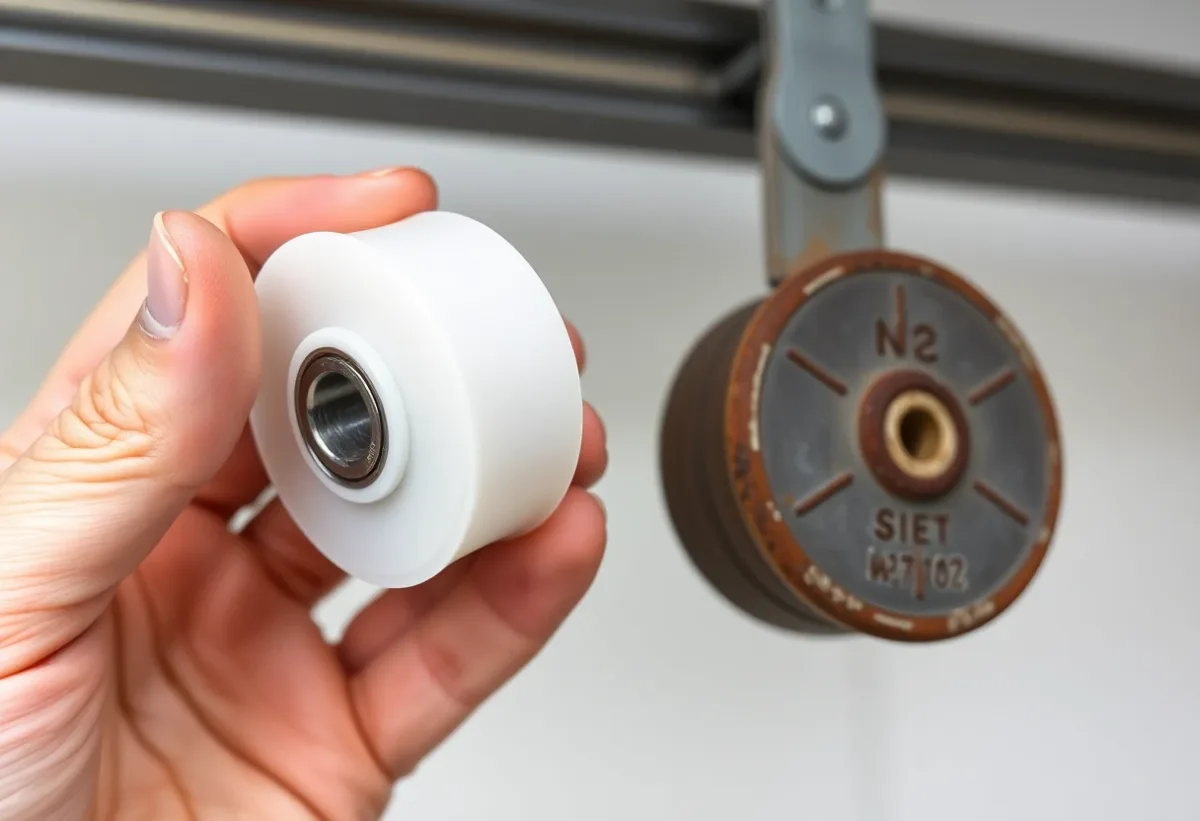
Anderson's Garage Door Company provides nylon roller upgrades throughout Seattle and the Puget Sound region — sealed-bearing nylon rollers that cut door noise dramatically — with same-day availability and flat, quoted-in-advance pricing.
This specialty falls under our broader garage door roller replacement service, and it's work our technicians perform constantly: the trucks are stocked for it, the diagnostic path is well-worn, and the fix almost always happens in one visit.
One call to (253) 453-8862 gets you a real local technician, a clear quote, and in most cases a same-day fix.
About nylon roller upgrades
In plain terms: sealed-bearing nylon rollers that cut door noise dramatically. Homeowners often discover they need it only after a louder, more expensive failure — which is why we check for the early signs on every service call.
When our technician handles nylon roller upgrades, the surrounding system gets inspected too: springs, cables, rollers, tracks, and opener settings all interact, and a fix that ignores the neighbors doesn't last.
If your door is hanging crooked, has a visibly separated spring, or has a cable dangling loose, stop using it immediately. Operating a compromised door can bend tracks, strip opener gears, and turn a modest repair into a full replacement.
Our garage door roller replacement process, step by step
We've refined this process over thousands of service calls across the Puget Sound region, and it's built to respect your time and your budget.
1. Honest phone diagnosis
Describe the symptoms over the phone and we'll tell you what it probably is, what it probably costs, and whether it's safe to use the door until we arrive.
2. A real arrival window
You get a specific window, a heads-up call en route, and a technician in a marked Anderson's truck — not a stranger in an unmarked van.
3. Full-system inspection
The technician checks the entire door, not just the obvious broken part, so the quote you approve reflects everything the door actually needs — and nothing it doesn't.
4. Flat-rate quote, then work
We present options — good, better, best where it applies — with firm numbers. Only after you choose do tools come out.
5. Test, tune, and clean up
We cycle the door repeatedly, verify the safety systems, lubricate every moving part, and walk you through what was done before we leave.
The seven parts that make or break your garage door
Most homeowners never think about the machinery overhead until it stops. In reality, every door cycle coordinates a half-dozen subsystems, and the failure you can see is often caused by a part you can't. Here's the system our technicians evaluate on every call in Northwest garages:
Springs: the muscle
Torsion or extension springs counterbalance the door's full weight — often 150–350 pounds — so a motor rated like a blender can lift it. Springs are consumables rated in cycles, and they are always the most dangerous part to touch.
Cables and drums: the transmission
Steel lift cables wind onto grooved drums at each top corner, converting spring torque into even lift. A frayed strand today is a snapped cable next month — and a snapped cable drops one side of the door instantly.
Rollers and tracks: the guide rails
The tracks don't bear the door's weight — the springs do — but they define its path. A quarter-inch of misalignment is audible; a half-inch binds the door entirely.
Hinges and panels: the body
Hinges let the door bend around the track's curve; panels give it structure. A cracked hinge telegraphs clicking sounds, while a sagging top panel strains the opener bracket it carries.
The opener: the brain
The motor head, drive (belt, chain, or screw), logic board, and travel/force settings automate the door. Most 'opener failures' we diagnose are actually door problems forcing the opener past its limits.
Safety systems: the guardian
Photo eyes six inches off the floor and force-reversal settings are what stop a closing door from striking a child, pet, or bumper. Federal law has required them since 1993, and we test them on every single visit.
Weather seals: the envelope
Seals are the only part of the system facing the weather full-time. In our climate they harden and flatten in a few years, and replacing them is one of the highest-value small jobs we do.
Need a garage door fixed today?
Free phone estimates · Same-day service · 24/7 emergency line · Licensed, bonded & insured
Call (253) 453-8862Why this matters in Western Washington
Between October and April, Puget Sound weather throws rain, windstorms, and the occasional cold snap at your garage door — and every one of those finds a weak spring, a frayed cable, or a dry bearing.
For nylon roller upgrades specifically, our parts choices reflect that reality — components rated for damp, coastal-adjacent duty rather than the cheapest catalog option.
A homeowner's garage door maintenance guide
A few minutes of seasonal attention dramatically extends the life of every component above. Here's the routine we recommend to customers — all of it safe for homeowners, none of it requiring tools near a loaded spring:
Monthly: watch and listen
Cycle the door and simply observe: smooth and quiet is healthy. Scraping, slapping, or a door that pauses mid-travel means wear is active and worth a phone call before it compounds.
Monthly: test the safety reverse
Lay a 2x4 flat where the door closes — the door should reverse within two seconds of touching it. Then wave an object through the photo-eye beam while closing; the door should reverse instantly. If either test fails, stop using the opener and call us.
Twice a year: lubricate the right way
A garage-door-specific silicone or white lithium spray on hinges, roller bearings (not nylon wheels), springs, and the opener rail — never WD-40, which strips lubricant and attracts grit. Wipe the excess; drips collect dust into grinding paste.
Twice a year: check the balance
With the door closed, pull the red release cord and lift the door halfway by hand. It should float there. If it slams down or flies up, spring tension is off — reconnect the opener and book a tune-up; an unbalanced door is quietly destroying its opener.
Yearly: professional tune-up
Once a year, let a technician do what homeowners safely can't: set spring tension, calibrate opener force and travel, and torque the hardware. It's the cheapest insurance a garage door can buy.
The real cost of putting it off
The mechanical truth about garage doors: no failure stays contained. Every cycle on a compromised system transfers stress to healthy parts. The difference between calling at the first grinding noise and calling after the door stops entirely is routinely several hundred dollars.
Then there's security and weather: a door that won't fully close is an open invitation through months of Northwest rain. Most of the calls we run as emergencies gave weeks of polite warning first.
The free move: call (253) 453-8862 and describe the symptom. The phone diagnosis costs nothing, and if it's genuinely safe to wait, we'll tell you that too.
What garage door roller replacement costs across our service area
Most garage door roller replacement jobs across our service area land between $120 and $280. Where your job falls in that range depends on door size and weight, the parts tier you choose, and how much neighboring hardware needs attention at the same time.
Beware of "$39 service call" ads — that model makes its money on pressure upsells once a tech is in your garage. Our approach is the opposite: a real quote up front, options explained plainly, and the final invoice matching the approved number.
Every repair we perform is covered by a written workmanship warranty, and the parts we install carry manufacturer warranties we register for you.
Available across the Puget Sound region
We provide nylon roller upgrades everywhere we operate: Des Moines, Puyallup, Lakewood, Tukwila, Black Diamond, Marysville, and the rest of our four-county service area. Same-day appointments are usually available — call (253) 453-8862.
The Anderson's difference
Anderson's Garage Door Company has been repairing and installing garage doors across the Puget Sound region since 2012, and our technicians arrive in fully stocked trucks so most jobs are finished in a single visit.
Our reviews average 4.9 stars, and we've earned them one driveway at a time: showing up when we said we would, charging what we quoted, and fixing doors so they stay fixed.
We quote flat, upfront pricing before work begins — the number you approve is the number you pay, with no trip-charge surprises when you proceed with the repair. Reach us at (253) 453-8862 any day of the week; emergency calls are answered around the clock.
And because we're local, accountability is real: the technician who fixes your door this year is the company you'll call next year. That long-game incentive — rare in an industry full of lead-generation fronts — is why we'd rather under-promise, over-deliver, and earn the next referral on your street.
Frequently asked questions
How do I know my rollers are worn out?
Listen and look: grinding or popping during travel, visible wobble in the stems, flat spots or cracks on the wheels, or a door that shudders in the curve of the track. Rollers are cheap compared to what a seized one does to tracks and openers.
How long does garage door roller replacement take?
Most appointments are finished in 60–120 minutes. Our trucks carry the common parts for every major brand, so the overwhelming majority of garage door roller replacement calls are completed in a single visit.
Do you warranty garage door roller replacement work?
Yes. Labor is covered by our written workmanship warranty, and parts carry their manufacturer warranties — which we register on your behalf. If something we installed misbehaves, we come back and make it right.
Do you service all brands for garage door roller replacement?
We work on every major residential brand — LiftMaster, Chamberlain, Genie, Craftsman, and Marantec openers; Clopay, Amarr, Wayne Dalton, C.H.I., and Raynor doors — plus builder-grade and discontinued brands found in older Puget Sound homes.
Is it safe to use my door until the technician arrives?
If the door is crooked, a spring is visibly separated, or a cable is hanging loose — stop using it. Running a compromised door can bend tracks and strip opener gears, turning a modest repair into a much bigger one. Disconnect the opener and leave the door where it is until we arrive.
How much does garage door roller replacement cost?
Most garage door roller replacement jobs run between $120 and $280, depending on door size, parts quality, and how much related hardware needs attention. We give you a firm, flat quote before starting — the price you approve is the price you pay.
Can I get same-day garage door roller replacement?
Usually, yes. Call (253) 453-8862 before early afternoon and we can typically have a technician out the same day. Emergency situations — doors stuck open, vehicles trapped — are prioritized around the clock.
What's the benefit of nylon rollers?
Sealed-bearing nylon rollers cut operating noise dramatically compared to worn steel rollers, don't need regular lubrication baths, and don't grind metal-on-metal in the track. It's the single best noise upgrade a door can get.
Ready when you are — 7 days a week, 7:00 AM – 9:00 PM (24/7 emergency line)
Free phone estimates · Same-day service · 24/7 emergency line · Licensed, bonded & insured
Call (253) 453-8862